
28-05-2026
News
Hungary
accounting career, payroll career, accountant career path, payroll specialist career, professional development , PS Tomorrow’s Leaders programme, GINOP training , Excel VBA training , leadership development
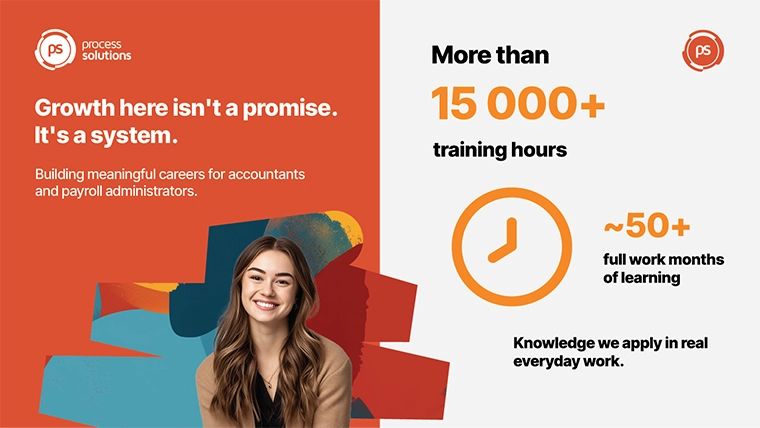
Over the past nearly two years — supported by the GINOP grant — more than 15,000 hours of training have been completed, and over 300 colleagues have earned certifications, many of them across multiple programmes.
“Learning at PS isn’t a standalone event — it’s part of how we operate. That’s why we designed our training programmes to create real, lasting change in everyday work.” — a member of the Learning & Development HR team
Digital skills: when Excel becomes a real competitive advantage
In accounting and payroll, Excel remains a core tool. Not because there’s nothing else out there, but because in many situations it offers the most flexibility — and it’s accessible to everyone.
In our advanced Excel trainings, colleagues don’t just learn new features — they learn how to build clear, stable data management structures: reports that hold up over time and don’t need to be manually rebuilt every time something changes.
The next step is automation. In our VBA trainings, participants replace specific, repetitive tasks and get a hands-on feel for how to consciously reduce manual work in accounting and payroll workflows.
“We didn’t just sit and listen — we actually had to think. And along the way, I realised how much can be automated.” — a team member
This mindset has a long-term impact on how effectively someone can operate in their role — and at what level.
How you work together matters too
Beyond a certain point, technical expertise alone isn’t what sets people apart — what makes the difference is how effectively someone can work with others.
Our personal effectiveness trainings were built around real, everyday situations. Using the DISC model, colleagues gain a better understanding of their own working style and how others respond, while assertive communication tools help them learn to express their views in a constructive way.
The time management modules were equally practical: the focus was on managing workload deliberately, setting priorities, and staying focused in a constantly changing environment. We’ve written in more detail about these approaches in our article on personal effectiveness trainings.
“We got real tools for practising assertiveness.” — a colleague.
These skills shape which direction someone can grow in their accounting or payroll career over the long term — and how confidently they can handle increasingly complex situations.
Stepping into leadership: the real challenge
At a certain point, professional growth is no longer just about expanding your knowledge — it also means stepping into a new role on the accounting or payroll career path.
That’s why our leadership programmes weren’t built as one-size-fits-all — they were tailored to each level. A new middle manager faces different challenges than a more experienced leader.
New leaders worked on the foundations of delegation, assertiveness, and situational leadership, while learning how to step out of micromanagement. More experienced leaders focused more on change management, energy management, and cross-generational collaboration.
At the management level, the programme went deeper: motivational models, emotional intelligence, trust-building, and neuroscience-based approaches all came into play.
A key element of the trainings was action learning, where participants worked together on real business challenges from their own teams.
“It wasn’t like reading a textbook — it was interactive, with a genuinely relaxed atmosphere.” — a participating leader
This is what ensures the learning doesn’t stay theoretical — it gets woven into day-to-day work.
What happens after the training ends?
The real value of any training shows up in the day-to-day work that follows.
Our programmes didn’t stop at the training sessions themselves: coaching conversations, group reflection, and peer knowledge-sharing helped embed what was learned into actual accounting and payroll processes.
The impact is visible in how the organisation moves. On average, 50–60 colleagues advance to the next level every six months — which shows that career development in accounting and payroll isn’t a one-off campaign here; it’s part of how we work.
Development starts on day one
Professional growth begins the moment someone joins. Our intentionally designed onboarding process helps new colleagues quickly understand how things work, get up to speed with confidence, and see clearly what professional and career opportunities are ahead of them.
This is especially important at assistant and entry-level positions, where personal effectiveness matters just as much as the professional fundamentals.
Everything else builds on this foundation: colleagues can progress along their own development path, taking on increasingly complex tasks and roles over time. For a closer look at the next level of leadership development, the PS Tomorrow’s Leaders programme offers a deeper dive.