
Project details
Description
Multi-entity payroll environment: the need for centralized payroll data
A Hungary-based corporate group operating through more than ten legal entities needed better visibility into payroll data across the organization.
Most entities ran payroll independently and maintained their own payroll solutions. While this structure supported local operations, it made it difficult for the central HR team to access consistent payroll information at group level.
For organizations operating across multiple entities, centralized payroll reporting requires more than payroll and HR outsourcing services alone – it also depends on structured, reliable data integration. At Process Solutions, these capabilities are part of our broader payroll services offering, and this project shows how we combine them in practice.
The organization therefore explored whether payroll data from multiple entities could be integrated into a centralized framework that would support structured reporting without compromising data security.
Payroll data integration challenges in multi-entity organizations
In multi-entity organizations, payroll data typically exists in separate systems. Each entity maintains its own payroll database due to strict data protection and compliance requirements.
This was also the case for the client. Payroll information was shared periodically, but the process was fragmented and inconsistent. Entities provided data in different formats, and the central HR team had to manually consolidate information to obtain a group-level overview.
The organization wanted to introduce a structured payroll data integration framework that would allow the central HR team to access standardized payroll information across all entities. The challenge was not only to extract payroll data from multiple independent databases, but also to define a reporting structure that would make the data consistent, usable and scalable at group level.
Designing a centralized payroll data integration framework
The project required close collaboration between three parties:
- the client’s HR and management teams
- an infrastructure provider supporting the reporting environment
- the payroll and development specialists at Process Solutions
The first phase of the project was to define the payroll reporting framework itself. Because no payroll-specific structure previously existed in the client’s reporting environment, Process Solutions worked together with the client and the reporting infrastructure provider to determine which payroll data points were needed, how they should be structured, and how the data flow should support centralized reporting. The final framework covered approximately 200 payroll data fields, creating a standardized basis for payroll reporting across multiple entities.
Two reporting layers were introduced:
- a daily payroll data package, providing frequently updated operational data
- a monthly payroll data package, supporting broader reporting needs
This structure allowed payroll data from different entities to be delivered in a consistent format suitable for centralized reporting.
Integrating payroll data from multiple payroll databases
A key technical challenge was the number of independent payroll databases involved.
Each entity maintained its own payroll database, which is standard practice in payroll environments. As a result, more than ten separate payroll databases had to be connected to the reporting framework.
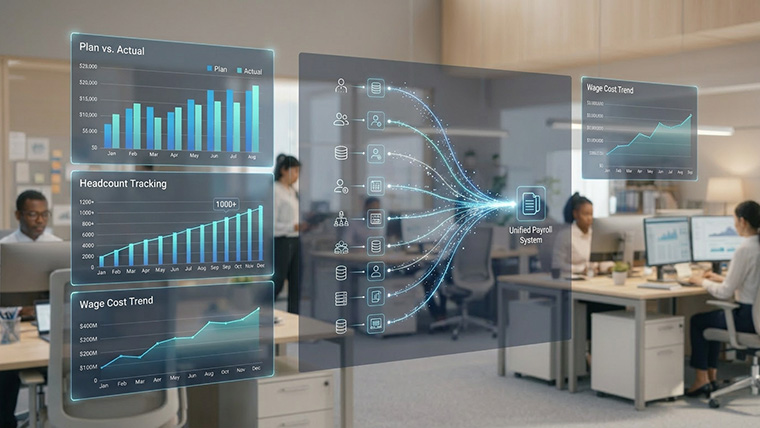
To enable centralized payroll data integration, Process Solutions developed a dedicated data integration layer capable of:
- extracting payroll data from each entity-level database
- transforming the data into a unified structure
- automatically delivering the processed data into the client’s reporting environment
A structured data transformation process was implemented to aggregate payroll data while maintaining strict separation between entity-level databases.
Process Solutions also developed an automated delivery mechanism that transfers the standardized payroll datasets securely into the client’s reporting environment, ensuring reliable and consistent data availability for reporting.
This solution gave the client an automated and reliable way to make payroll data available for centralized reporting across a complex multi-entity environment.
Automated payroll data delivery at enterprise scale
The implemented architecture enables automated payroll data delivery across all entities.
The scale of the data flow illustrates why automation is essential. The reporting framework includes approximately 200 payroll data fields and processes information related to more than 1,000 employees across the organization.
Approximately two-thirds of the data fields are delivered as part of the daily data package, while the remaining data points are included in the monthly reporting dataset. Managing such a process manually would be extremely difficult and would introduce a significant risk of errors.
Following implementation, the system was closely monitored for one month to ensure stable operation and accurate data transmission.
Although the overall timeline extended beyond the original plan due to coordination requirements, the development and implementation work itself required only a few months.
Results: centralized payroll reporting across multiple entities
The project resulted in a scalable payroll data integration framework connecting more than ten entities within the organization.
Payroll data from multiple independent databases can now be collected, transformed and delivered automatically in a standardized format into the client’s reporting environment. Based on this newly established payroll data foundation, the organization can generate consistent group-level payroll reporting without manual consolidation across entities.
Today the system operates reliably with minimal intervention and supports structured payroll reporting across the organization.
Beyond improving reporting, the project demonstrates how centralized payroll data integration can improve group-level visibility while maintaining strict payroll data security requirements.
Supporting complex payroll operations
Organizations operating multiple entities frequently face challenges when managing payroll data visibility and reporting. Integrating payroll data across multiple systems requires both payroll expertise and a well-designed operational framework.
At Process Solutions, we help international organizations combine payroll outsourcing, payroll automation and structured payroll reporting to standardize and scale payroll data flows across complex multi-entity environments, creating a reliable foundation for centralized reporting and group-level visibility.
Learn more about our payroll outsourcing solutions and how we support scalable multi-entity payroll operations.
FAQ
What is payroll data integration?
Payroll data integration is the process of collecting payroll data from multiple systems or entities, transforming it into a standardized structure, and delivering it for centralized reporting or analysis.
Why is payroll data integration important for HR teams?
Payroll data integration provides consistent and structured data across entities, enabling centralized reporting, better visibility, and more reliable decision-making at group level.
How can companies integrate payroll data across multiple entities?
Companies integrate payroll data by extracting information from entity-level payroll databases, transforming it into a standardized structure, and delivering it through automated data pipelines or APIs into a centralized reporting environment.
What are the challenges of payroll data integration?
The main challenges include separate payroll databases, inconsistent data structures, data security requirements, and the need to automate data consolidation across multiple entities.