

Project details
Description
When automation capability exists, but opportunities remain unclear
Many shared service centers already have access to automation tools and supporting governance structures. Yet despite these capabilities, they often struggle to identify where automation can create meaningful business value.
This case study shows how Process Solutions helped a shared service center uncover more than 50 automation opportunities across finance functions through a focused, structured discovery approach delivered within weeks.
The challenge: Limited visibility into automation potential
The client operated a shared service center with around 200 FTE and was working against clear efficiency expectations. Automation capabilities were already available at group level, supported by internal resources, external vendor involvement, and an established governance model.
Even so, the organization faced a common challenge: while the tools and framework for automation existed, practical automation opportunities were not clearly visible within day-to-day operations.
The core issue was not a lack of interest in automation or a lack of supporting infrastructure. The real challenge was identifying where automation could deliver tangible value across finance processes in a structured and actionable way.
Why this happens in shared services environments
In many shared services environments, automation potential remains hidden not because processes lack opportunity, but because process knowledge alone is often not enough to reveal it.
Business teams know their activities in detail, but identifying realistic automation opportunities requires a different perspective: one that combines process understanding with practical knowledge of automation possibilities and a clear view of how process ownership impacts automation outcomes, as explored in how process owners make automation pay off. Without that structured discovery capability, organizations may underestimate what can be improved and focus too narrowly on a limited set of obvious use cases.
This is especially true in finance operations, where repetitive activities, controls, validations, handoffs, and system interactions often create significant automation potential that is not immediately visible at first review.
The approach: Structured automation discovery in finance
Process Solutions was engaged to carry out a focused automation opportunity assessment across selected finance functions within the shared services environment.
The scope covered approximately 100 FTE, and the work was completed over a short assessment period within weeks. The approach was intentionally focused and lightweight, reflecting the client’s need for rapid, practical insight rather than a longer and more exhaustive assessment. The objective was not to evaluate automation in theory, but to identify concrete opportunities that could improve efficiency in practice.
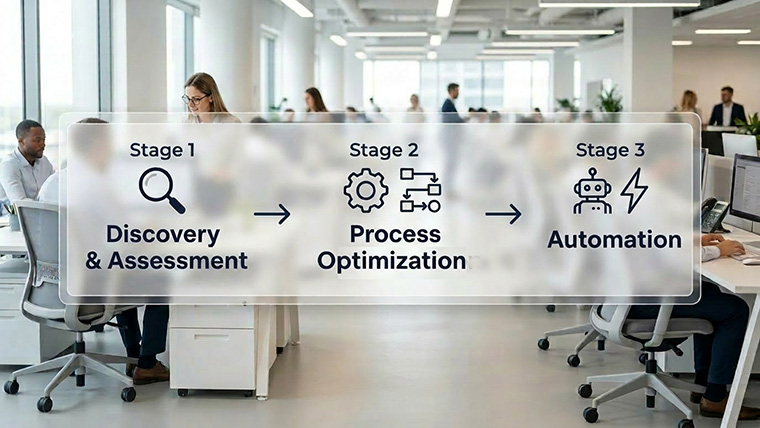
The assessment combined several elements:
- structured stakeholder interviews
- process walkthroughs
- documentation analysis
A total of eight in-depth interviews were conducted with key business stakeholders and process experts. Strong client collaboration, openness, and stakeholder availability played an important role in making it possible to generate meaningful results within a short timeframe. This allowed the team to understand how work was actually performed, where repetitive effort occurred, where manual checks and handoffs created friction, and which activities could potentially be automated.
Importantly, the assessment looked beyond a narrow RPA-only lens. The goal was to identify automation opportunities more broadly, including areas where different forms of practical automation could support process efficiency.
What Process Solutions contributed
The value of the project came from more than simply reviewing process documentation.
Process Solutions brought a structured discovery methodology combined with practical automation knowledge in a finance context. This made it possible to translate operational realities into a clear set of automation opportunities that the organization could evaluate and act on.
Rather than starting from tools, the assessment started from business activities and process pain points. This helped reveal opportunities that were relevant, realistic, and aligned with the operational environment.
The outcome: 50+ automation opportunities identified
The assessment identified 50+ automation opportunities across the in-scope finance functions.
This significantly expanded the organization’s view of what could potentially be automated. What had previously appeared to be a limited field of opportunity turned out to contain a much broader range of viable use cases.
The identified opportunities covered a range of repetitive and structured activities, including tasks involving data handling, validations, reconciliations, and cross-system administrative work. Together, they provided a much clearer picture of where automation could support operational efficiency.
From findings to structured decision support
A key strength of the project was that the output was not just a collection of observations.
The identified opportunities were organized into a structured, scored opportunity assessment, giving the client a clearer basis for evaluating next steps. This made the findings more usable for internal discussion and decision-making, while reducing the risk that the assessment would remain a theoretical exercise, similarly to how successful initiatives balance priorities as outlined in delivering quick results in digital transformation.
The result was a practical overview of automation potential grounded in actual process realities rather than broad assumptions.
Key takeaway: Tools do not create value on their own
One of the clearest lessons from the project was that automation capability alone does not guarantee automation value.
Even when organizations already have access to tools, governance, and support structures, meaningful opportunities may remain undiscovered without a structured way to assess them. This project also showed that, with the right methodology and strong stakeholder engagement, valuable automation insight can be generated in a matter of weeks.
In this case, the decisive factor was not new technology, but the ability to combine process understanding with automation expertise and apply that through a focused discovery approach.
For organizations operating in shared services environments, this is an important insight: the first step toward better automation outcomes is often not implementation, but visibility.
Supporting digital transformation through structured discovery
Automation should be part of a broader digital transformation journey, especially in finance operations where efficiency, accuracy, and scalability are closely linked.
At Process Solutions, we help organizations uncover automation potential through structured discovery, process-focused assessment, and practical prioritization. By combining finance process understanding with automation domain knowledge, we support clients in identifying where automation can create real business value, as demonstrated in our touchless accounts payable automation solution.
Learn more about how we support digital transformation and operational efficiency across finance processes